Immune Cells as Biosensors in Lupus
New insights into individual immune activation in SLE
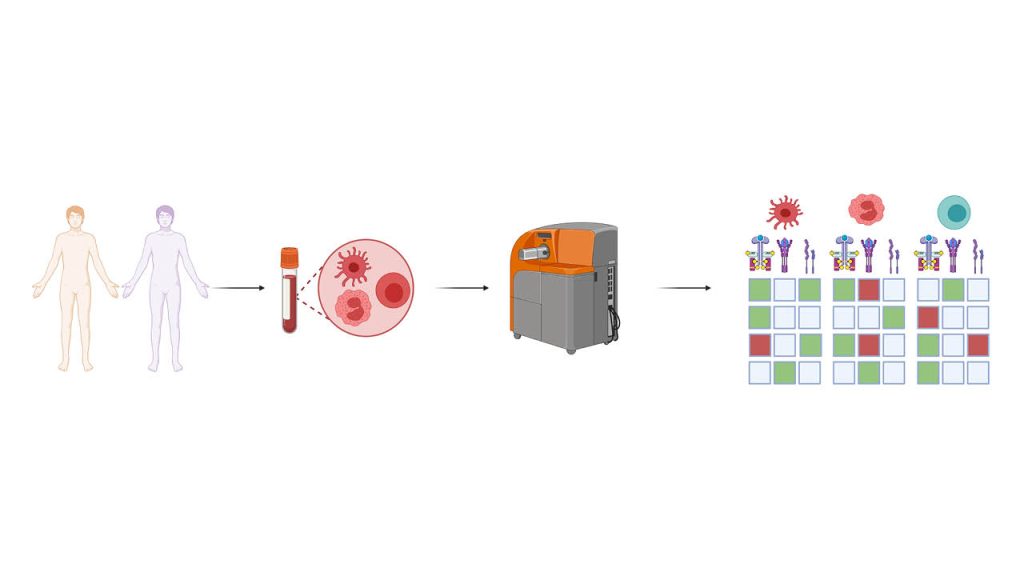
A research team from DRFZ and Charité – Universitätsmedizin Berlin has developed a novel method to investigate the activity of immune cells directly in a blood sample without artificially stimulating the cells beforehand. Using the mass cytometric approach known as Unperturbed Activation Profiling (UACT), they examined the natural activation of immune cells in systemic lupus erythematosus (SLE). The method reveals patterns of immune activity that may be associated with various disease characteristics. Initial results also show that changes in immune activity during therapy can be measured. As future application, UACT could help to characterize patients more accurately, identify treatment success early on, and tailor treatments more closely to individual immune activity. The results were published in the journal Frontiers in Immunology.
In a proof-of-concept study involving 20 SLE patients and 20 healthy controls, colleagues from the Mass Cytometry Technology Platform assessed the activity of immune cells. The UACT allows the measurement of which signaling pathways are active in individual immune cell types in unstimulated, briefly fixed blood samples.
In a proof-of-concept study with 20 SLE patients and 20 healthy controls, SLE patients showed particularly elevated phosphorylation signals of the signaling proteins STAT1, STAT3, and STAT5. These changes occurred across various immune cell populations, especially in naïve T cells as well as in additional T, NK, and myeloid cells. Activation patterns differed markedly between patients and partially reflected distinct autoantibody profiles and disease manifestations.
UACT profiles enabled better separation of SLE patients from healthy controls than analysis of cell frequencies alone. Furthermore, five exploratory patient groups with different signature combinations and clinical-immunological characteristics could be identified. In a small longitudinal investigation of four patients with therapy-refractory skin manifestations, a good response to the JAK1/2 inhibitor baricitinib was associated with elevated baseline pSTAT3 levels and a subsequent decline in STAT3 phosphorylation.
The results demonstrate that peripheral immune cells can serve as “biosensors” of an individual’s inflammatory environment. In the future, UACT could help to better characterize immunological patient subgroups, monitor treatment effects, and develop biomarkers for more personalized treatment of chronic inflammatory diseases.
Original publication
Project leader

Technology platform Mass Cytometry