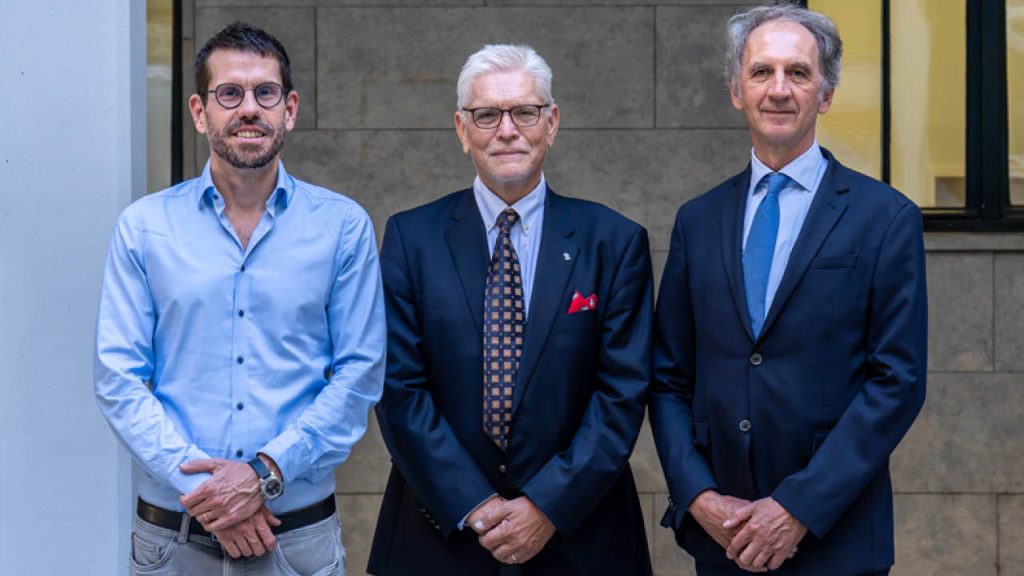
Gerhard Krönke awarded Novartis Prize for immunological research with therapeutic relevance
Prof. Dr. Gerhard Krönke, Director of the Department of Medicine for Rheumatology and Clinical Immunology at Charité – Universitätsmedizin Berlin and Head of the Liaison…
Prof. Dr. Gerhard Krönke, Director of the Department of Medicine for Rheumatology and Clinical Immunology at Charité – Universitätsmedizin Berlin and Head of the Liaison…
Statement by the Leopoldina On October 1, 2026, the German National Academy of Sciences Leopoldina issued a comprehensive statement on the care, data infrastructure, research,…
Antibodies protect our body – but they can also attack it. Researchers at the German Rheumatology Research Center (DRFZ), a Leibniz Institute, and Charité –…
Carlo Veltri honored with prize for health services research Carlo Veltri was honored on September 9, 2026, during the opening ceremony of the German Rheumatology…
Rheumatology Monitor: A Dashboard for Rheumatology Dr. Johanna Callhoff, head of the Health Services Research Group at the DRFZ, was awarded one of the prizes…
Julia Polansky was selected by the Tagesspiegel Prof. Dr. Julia Polansky, Liaison group leader of the research group Immuno-Epigenetics at DRFZ and Professor for Immuno-Epigenetics…
An important milestone has been reached in the BMG-funded project “Linkage of Cancer Registry Data with Other Medical Registries” (LinkMedR): Data from medical registries and…
New insights into individual immune activation in SLE A research team from DRFZ and Charité – Universitätsmedizin Berlin has developed a novel method to investigate…