Precision Therapy Against Disease-Causing Plasma Cells
Antibodies protect our body – but they can also attack it. Researchers at the German Rheumatology Research Center (DRFZ), a Leibniz Institute, and Charité – Universitätsmedizin Berlin have developed a new method to specifically remove the plasma cells that produce disease-causing antibodies. Plasma cells that protect the body and the rest of the immune system remain intact—a promising approach for treating antibody-mediated diseases. The findings have now been published in the journal Proceedings of the National Academy of Sciences USA.
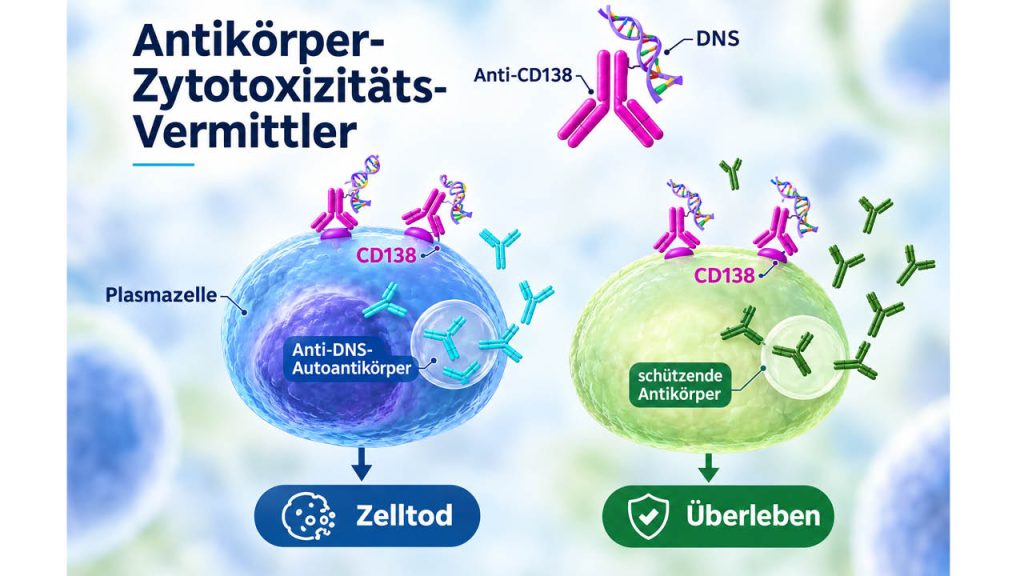
Antibodies protect us from many diseases, but they can also cause diseases themselves when they turn against the body. More than 10% of people in Germany are affected by such antibody-mediated diseases. Scientists at Charité and DRFZ, led by Prof. Falk Hiepe and Prof. Andreas Radbruch, have now developed a method to specifically remove the plasma cells that produce such pathogenic antibodies in these patients. These cells are killed by their own antibodies. Plasma cells that produce other, protective antibodies are not affected, and the patients’ immune systems are not damaged—unlike with currently available therapies.
In a mouse model for systemic lupus erythematosus, the scientists were able to show that the selective removal of plasma cells that produce antibodies against DNA prevents kidney inflammation. To do this, they developed a drug that binds a short segment of DNA on all plasma cells. When injected into mice, the plasma cells that secreted DNA-specific antibodies were killed by their own antibodies. The drug is a prototype of a new class of “antibody-mediated cytotoxicity engagers” (ACE), which could be used to specifically target and eliminate pathogenic plasma cells in other diseases as well. The key advantage of this new therapeutic approach is that the patients’ immune systems remain intact, and only the pathogenic cells are eliminated.
Original publication
Scientists involved in the project




Figure: Falk Hiepe & KI